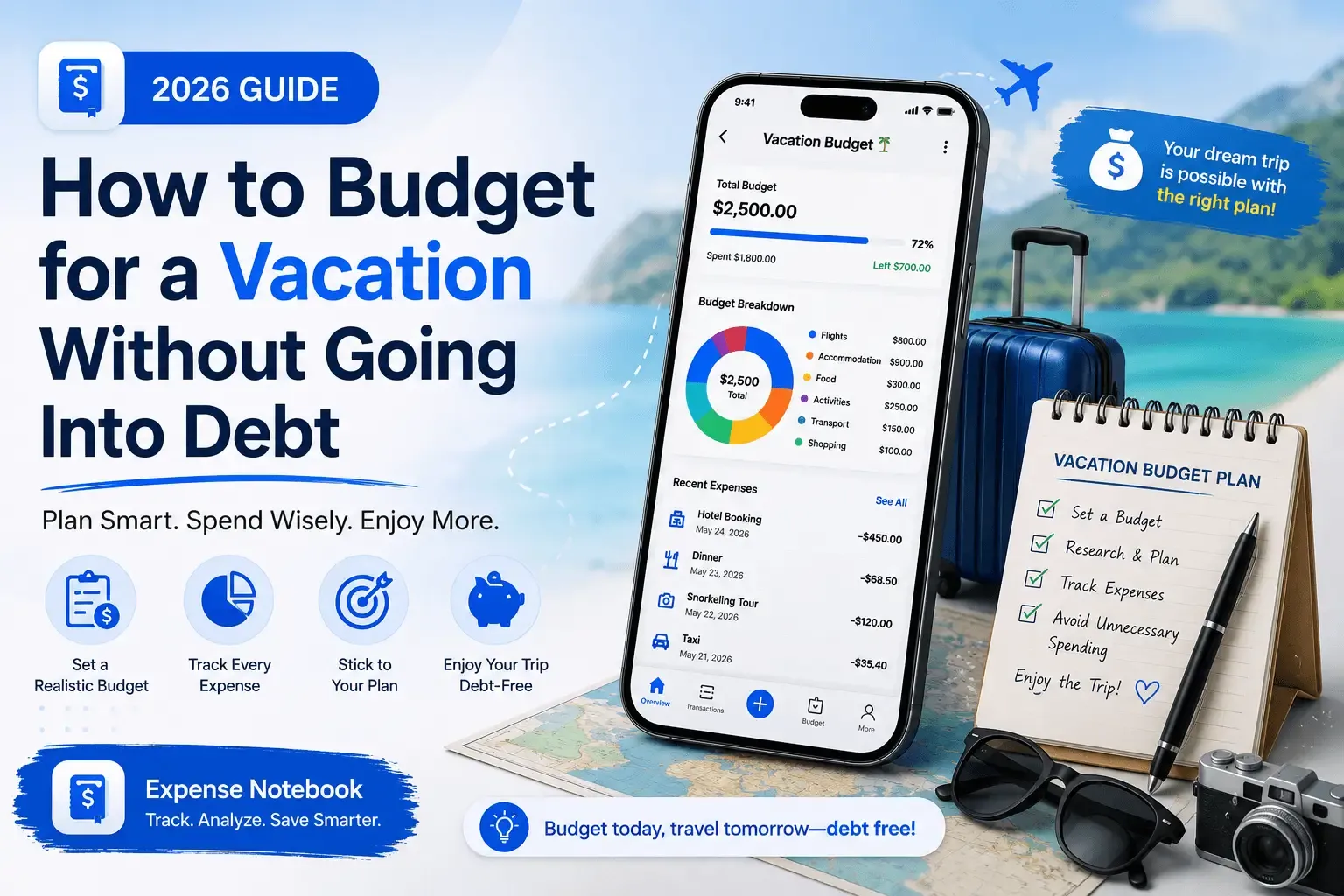
To budget for a vacation without going into debt: (1) Set a firm total trip budget before booking anything. (2) Break it into 6 categories — flights, accommodation, food, activities, transport, and a 15% emergency buffer. (3) Open a dedicated vacation savings account and automate monthly transfers from today. (4) Book the two biggest costs — flights and accommodation (first and earliest). (5) Track every pre-trip and on-trip expense in real time using AI Expense Notebook, so overspending is caught before it becomes debt. The average vacation costs $1,991–$2,400 per person in 2026. Starting to save 6 months out means setting aside $332–$400/month — achievable without lifestyle overhaul.
The Real Cost of Vacation in 2026 — And Why So Many People Get It Wrong
Vacations are one of the most anticipated and most financially mismanaged expenses in personal finance. People plan the destination, the hotels, the activities — and completely fail to plan the budget. Then they come home, open a credit card bill, and spend the next six months paying off a trip they took in six days.
Nearly 1 in 5 Americans (17%) say they would go into debt to pay for a vacation. Among those who do, the average vacation debt is $2,525. NerdWallet's 2026 Summer Travel Report found that 23% of summer travelers will charge vacation expenses to a credit card and won't pay it off right away. A $1,500 trip financed at 21% APR costs $1,815 if carried for 12 months — you pay $315 extra for the same trip, after you've already come home.
The problem is almost never the desire to travel. It's the absence of a real, tracked budget. Most people set a rough number in their head ('this trip should cost about $1,500'), book flights and hotels on a credit card, and then spend freely on-trip because 'we're already here.' The final bill arrives three weeks later and is always higher than expected.
This guide gives you the exact system to plan, save, and track a vacation budget that works — so the only thing you bring home from your trip is memories, not debt.
What a Vacation Actually Costs in 2026 — Category by Category
Before you can build a budget, you need realistic numbers. Most people underestimate vacation costs because they only think about flights and hotels. A real vacation budget has six cost categories:
The average domestic vacation costs $2,400 per person for a 7-day trip in 2026. International vacations average $4,500 per person. A family of four spends an average of $7,200 domestically. Accommodation accounts for 35% of the total — the single largest expense. Transportation (flights + ground) is 28%. Together they consume 63% of the average vacation budget. Source: SpendMeNot, NerdWallet 2026 Travel Data.
Category | % of Budget | Budget Trip | Mid-Range | Luxury |
Flights / Transport | 28% | $200–$350 | $500–$900 | $1,500–$3,000+ |
Accommodation | 35% | $280–$500 | $700–$1,200 | $2,000–$5,000+ |
Food & Dining | 18% | $37/day | $96/day | $200+/day |
Activities & Tours | 10% | $50–$150 | $200–$500 | $500–$2,000+ |
Local Transport | 5% | $30–$80 | $100–$200 | $200–$500 |
Emergency Buffer (15%) | 4% | Always add | Always add | Always add |
TOTAL per person (7d) | 100% | $600–$1,100 | $1,700–$2,900 | $4,500–$11,000+ |
Two things jump out from this table. First, flights and accommodation together consume 63% of your budget — these are the two numbers to lock in early. Second, the emergency buffer is not optional. Budget travelers who skip it are the ones who put unexpected costs on a credit card mid-trip.
The Hidden Costs Most Travelers Forget to Budget
Beyond the six main categories, experienced travelers know that the following costs appear on almost every trip and almost never appear in first-draft budgets:
- Travel insurance: $50–$200/trip — skipping it saves money until it costs you thousands
- Airport transfers & parking: $30–$150 each way, often $20–$50/day for airport parking
- Checked baggage fees: $35–$80 per bag each way on many domestic and budget carriers
- Visa fees: $25–$200 per person for many international destinations
- Currency exchange margins: 2–5% loss on every transaction without a travel-friendly card
- Resort/hotel fees: "Destination fees" of $20–$50/night added at checkout, not in the listed price
- Tipping: $10–$30/day in countries with strong tipping culture — adds up over 7 days
- Souvenir & gift budget: Often unplanned, frequently $50–$200 per person
- Food delivery on rest days: Tiredness on travel days leads to $30–$50 delivery orders
- Museum & attraction entry fees: $15–$40 per attraction — visits multiply quickly
AI Expense Notebook tip: Set a budget category for 'Hidden Costs / Buffer' before your trip and load it with 15% of your total budget. Every time one of these surprise costs hits, log it immediately in AI Expense Notebook. You'll see exactly how fast the buffer is draining — and whether you need to adjust spending in other categories.
→ See also: How to stick to a monthly budget
The 6-Step Vacation Budget Plan (Before You Book Anything)
The most important rule of vacation budgeting: set the number before you fall in love with the destination. Once you've emotionally committed to Bali or Barcelona, your brain rationalises every overspend. Set your ceiling first. Then choose a trip that fits inside it.
Step 1: Set Your Total Vacation Ceiling Before Researching Destinations
Start with what you can afford — not what the trip costs. A practical rule: spend no more than 5–10% of your annual net income on a single vacation. So if you earn $50,000 net, your vacation ceiling is $2,500–$5,000. If that sounds too low for the trip you want, you have two options: save longer or choose a different destination. What you don't do is set a ceiling of $1,500 and spend $2,400.
Write the number down. This is your hard limit. Everything else in this plan fits inside it.
Step 2: Split Your Ceiling Across the 6 Budget Categories
Take your total budget and allocate it across flights, accommodation, food, activities, local transport, and your emergency buffer. Use the percentage breakdown from the cost table above as a starting point, then adjust based on your trip priorities — if food and dining is a major part of why you're going somewhere, take from activities; if the destination is mostly outdoor/free, cut activities and add food.
The key is having a number for each category before you spend in any of them. A total budget without category splits is just a number — it doesn't stop you from booking a $300/night hotel when you budgeted $150.
Step 3: Research Real Costs Before You Commit to Anything
Armed with your category budgets, research whether your destination is actually achievable within them. Check Google Flights for realistic airfare. Check Booking.com or Airbnb for accommodation in your date range. Check Numbeo.com or Budget Your Trip for average daily costs at your destination.
If the real numbers exceed your category budgets, adjust now — not after booking. Either choose a cheaper destination, travel in shoulder season (typically 25–40% cheaper than peak summer), or save for longer.
Step 4: Book Flights and Accommodation First — These Lock in 63% of Your Budget
Once your budget is set and researched, book the two biggest costs first. Flights and accommodation together consume 63% of the average vacation budget. Locking them in early serves two purposes: it gives you a fixed total for the remaining 37%, and it prevents the most common vacation overspend — booking flights, then choosing accommodation that's more expensive than planned because 'we've already committed to the trip.'
According to Expedia's 2026 Air Hacks Report, Tuesday is the cheapest day to fly domestically, with fares averaging 14% below Sunday prices. Booking 2–3 months out for domestic and 4–6 months for international typically gives the best price-to-flexibility balance.
Step 5: Open a Dedicated Vacation Savings Account
A vacation savings account keeps your travel fund separate from everyday spending — preventing the slow erosion of money you intended for the trip. Transfer your monthly savings amount automatically on payday (you won't miss money that leaves before you see it). Use a high-yield savings account to earn interest while you wait.
Set up your vacation savings goal in AI Expense Notebook's Savings Goal tracker. Enter your total budget, set a deadline 30 days before departure (so you arrive fully funded), and the app shows exactly how much to transfer each month and your live progress toward the goal.
Step 6: Track Every Pre-Trip and On-Trip Expense in Real Time
A vacation budget that isn't tracked is a budget that doesn't exist. Most people set a budget, then stop looking at it the moment they arrive. By day 3, they're spending as if the trip is free.
Use AI Expense Notebook to track every expense — before the trip (gear, currency exchange, bags, insurance) and on the trip (every meal, activity, transport, and impulse purchase). Scan receipts in 3 seconds with AI Magic Scan. Log cash purchases in 8 seconds manually. Check your category budget bars daily. When Food & Dining hits 80% on day 4 of 7, you know to cook one more meal rather than book another restaurant — before the damage is done.
Your Vacation Savings Timeline: How Much to Save and When to Start
The single most powerful vacation budgeting decision is when you start saving. Starting earlier doesn't require changing your lifestyle — it just distributes the cost across more months, making each monthly contribution smaller.
Start Saving | Months to Go | $1,500 Trip | $2,500 Trip | $4,500 Trip |
12 months out | 12 | $125/month | $208/month | $375/month |
9 months out | 9 | $167/month | $278/month | $500/month |
6 months out | 6 | $250/month | $417/month | $750/month |
4 months out | 4 | $375/month | $625/month | $1,125/month |
2 months out | 2 | $750/month | $1,250/month | $2,250/month ⚠️ |
1 month out | 1 | $1,500 now | $2,500 now | $4,500 now — credit card territory ❌ |
The table makes the case for early action clearly: waiting until 2 months out to fund a $2,500 trip means finding $1,250 in a single month. Waiting until 1 month out means the credit card. Starting 9 months out means $278/month — less than most people spend on food delivery.
The Sinking Fund Method for Vacation Savings
A vacation sinking fund is a dedicated savings account or envelope allocated specifically to your next trip. Here's how to set one up in three steps:
- Open a separate high-yield savings account and name it for the destination — 'Japan 2027' is more motivating than 'Savings Account 3'
- Set up an automatic transfer on payday equal to your monthly savings target — before the money lands in your main account
- Track progress in AI Expense Notebook's Savings Goal feature — set the destination name, total budget, and deadline, and the app updates your monthly target automatically as you log contributions
Psychology note: Naming your savings account after a specific destination increases follow-through. 'Spain 2027' is a goal with a face. 'Holiday Savings' is an abstraction. Specific goals survive contact with temptation better than abstract ones.
How to Track Vacation Spending in Real Time — Without Ruining the Trip
Tracking expenses on holiday sounds like the opposite of relaxing. It isn't — when it takes 3 seconds per receipt. Here is the exact on-trip tracking system using AI Expense Notebook that keeps you inside budget without becoming your holiday hobby:
Before You Leave Home
- Set your 6 category budgets in AI Expense Notebook's budget planner — flights, accommodation (pre-paid), food, activities, transport, buffer
- Enter your pre-trip costs already spent: travel insurance, currency exchange, luggage fees, pre-booked tours
- Set your trip dates as a custom budget period so the app tracks the trip, not the calendar month
- Download offline maps so you have the app everywhere — AI Expense Notebook manual entry works offline
- Exchange currency before you leave — log the total exchanged as your cash float in the app
During the Trip — Daily Routine (Under 5 Minutes Total)
Sustainable on-trip tracking requires a daily routine light enough that you actually follow it. Here is the system:
⏱ Morning (30 seconds)
Open AI Expense Notebook. Check yesterday's category totals. See if any category is running ahead of pace for the number of days remaining. Adjust today's plan if needed — e.g. if food ran 30% over yesterday, plan a market lunch instead of a restaurant.
⏱ At every transaction (3–8 seconds)
Receipt received → AI Magic Scan immediately. No receipt (street food, tuk-tuk, market) → Add Manually in 8 seconds. The rule: log it before you leave the establishment. Once you're walking away, the amount starts to blur.
⏱ Evening (2 minutes)
Open Insights. See today's total spend across all categories. Check your remaining daily budget for the rest of the trip. This takes 90 seconds and prevents the day-6 panic when you realize you've spent 85% of your budget with 2 days left.
Handling Multi-Currency Spending
AI Expense Notebook supports multi-currency tracking, which is essential for international travel. When you pay in local currency, log the local amount — the app stores it accurately. This eliminates the mental maths of constantly converting to home currency and lets you see your spending in real terms.
→ Set your home currency in Settings before departure
→ Log all local currency expenses in local currency — avoids conversion errors
→ For credit card purchases with foreign transaction fees, add a note: the fee will appear on your statement and should be logged as a separate 'hidden cost' entry
→ At trip end, the Insights tab shows your total spend in home currency for a clean final figure
Download AI Expense Notebook free: App Store (iOS) · Google Play (Android)
→ See also: How to save $1000 in 3 months
Real Budget Examples: What Different Vacations Actually Cost in 2026
Abstract budgeting advice is hard to apply without real numbers. Here is what different trip types actually cost per person in 2026 based on current travel data — so you can build your budget with realistic figures, not guesses:
Trip Type | Duration | Budget/Person | Mid-Range/Person | Notes |
Domestic road trip (USA) | 7 days | $600–$900 | $1,200–$1,800 | Gas, motels, food; skip flights |
Domestic city break (fly) | 5 days | $900–$1,300 | $1,800–$2,400 | Avg domestic flight $290pp |
Mexico / Caribbean | 7 days | $1,200–$1,800 | $2,500–$3,500 | All-inclusive can save on food |
Western Europe | 7 days | $2,000–$2,800 | $3,500–$5,000 | Flights avg $650–$900; hostels save |
Southeast Asia | 10 days | $1,500–$2,200 | $2,800–$4,000 | Low daily cost offsets long flight |
Japan | 10 days | $2,500–$3,500 | $4,000–$6,000 | Flights avg $1,364; food is cheap |
Family of 4 (domestic, fly) | 7 days | $4,000–$6,000 | $7,000–$10,000 | Avg $7,200 per NerdWallet 2026 |
Use these as starting benchmarks, then research your specific destination. Numbeo.com gives real-time cost-of-living data by city. Google Flights lets you set price alerts for your route. Budget Your Trip gives daily averages broken down by spending type.
Key insight from the data: Southeast Asia costs 30–40% less per day than Western Europe once you arrive, but the long-haul flights partially offset the saving for trips under 10 days. For budget travelers, domestic road trips and Mexico/Caribbean offer the best total-cost-to-experience ratio in 2026.
12 Proven Strategies to Cut Your Vacation Budget Without Cutting the Experience
Once you have a realistic budget, these strategies help you stay inside it or stretch it further without compromising the trip:
1. Travel in Shoulder Season
Summer (June–August) is 25–40% more expensive than shoulder season at most destinations. April–May and September–October offer lower prices, smaller crowds, and usually better weather than peak summer in many European and Asian destinations. A $2,400 summer trip to Greece can become a $1,600 September trip — for the same hotels and restaurants, with fewer tourists. Savings potential: $200–$800/person
2. Book Flights on Tuesday
Expedia's 2026 Air Hacks Report found that Tuesday is the cheapest day to fly domestically, with fares averaging 14% below Sunday (the most expensive day). For a $400 flight, that's $56 saved per ticket — $112 for a couple — just by changing which day you fly. Savings potential: 10–15% on flight cost
3. Set Google Flights Price Alerts
For any trip more than 6 weeks out, set a price alert on Google Flights for your route. Prices fluctuate by $50–$200 week to week. Booking when the alert drops rather than when you feel like booking saves real money with no extra effort. Savings potential: $50–$200/ticket
4. Eat Lunch as Your Main Restaurant Meal
The same restaurant charges 30–50% less for lunch than dinner at the same table. Making lunch your main sit-down restaurant meal and choosing markets, bakeries, or takeaways for dinner cuts food costs substantially without sacrificing quality. Budget travelers spend $37/day on food; mid-range spend $96/day. This one habit moves you closer to the budget column. Savings potential: $20–$40/day
5. Stay One Zone Out from the Centre
Accommodation one neighbourhood or suburb away from a city's tourist centre costs 30–50% less and is typically 10–20 minutes by metro from the same attractions. In Paris, staying in the 11th or 20th arrondissement instead of the 1st saves €50–€100/night for equivalent hotel quality. Savings potential: 30–50% on accommodation
6. Use a Travel Credit Card (and Pay It Off Immediately)
Travel credit cards offer air miles, hotel points, and foreign transaction fee waivers that reduce overall vacation costs. The critical rule: only use a travel card if you will pay the full balance on the first statement. The NerdWallet 2026 survey found 61% of travel credit card users do this. The 23% who don't pay immediately convert their rewards into high-interest debt. Savings potential: 1–5% cashback or equivalent points on all spend
7. Buy a City Tourism Pass
Most major cities offer tourism cards combining public transport and museum entry for a flat daily rate. In Rome, the Roma Pass covers metro, buses, and major museums for €32/2 days. Buying individual museum tickets often costs more. Research whether a pass makes sense for your specific itinerary. Savings potential: $15–$40/person/day in major cities
8. Set a Daily Spending Limit and Check It Every Morning
Divide your remaining non-fixed budget (everything except flights and pre-paid accommodation) by the number of trip days. This is your daily spending target. Check your AI Expense Notebook Insights tab every morning to see yesterday's total and whether you're on pace. Days where you spend under-target buy you flexibility for a special dinner or activity later in the trip. Savings mechanism: prevents day-by-day drift that compounds into 20–30% overspend
9. Book Activities in Advance for Early-Bird Pricing
Popular attractions — national parks, theme parks, famous museums, guided tours — charge less when booked in advance and often sell out at peak times. Pre-booking also forces you to commit to a specific itinerary, which reduces the on-trip impulse to add expensive last-minute activities. Savings potential: 10–30% on activities vs. on-the-day pricing
10. Bring an Empty Refillable Water Bottle
Buying bottled water adds $3–$8/day in tourist destinations — $21–$56 for a 7-day trip. In most Western cities and many hotels, tap water is safe and free. A refillable bottle eliminates this cost entirely. Savings potential: $20–$60/person/week
11. Exchange Currency Before You Leave (or Use a No-Fee Card)
Airport exchange bureaus charge 8–15% margins. Hotel exchanges are similar. Using your regular debit card abroad often triggers 2–3% foreign transaction fees plus a fixed fee per transaction. Exchange in your home country before departure, or use a travel card (Wise, Revolut, Charles Schwab) with no foreign transaction fees. Savings potential: 2–15% on all cash transactions
12. Track Every 'Small' Purchase — They're Not Small
On holiday, the mental accounting shifts: 'we're on holiday, it doesn't count.' It counts. A $5 coffee, an $8 ice cream, a $12 guidebook, a $4 bottled water — four small purchases a day adds $29/day or $203 over a 7-day trip. Log all of them in AI Expense Notebook. Seeing them totalled is what keeps the 'it doesn't count' logic from blowing your food budget. Savings mechanism: makes invisible spending visible, which reduces it by 15–25%
The Post-Trip Review: What to Do When You Get Home
The 48 hours after returning from a vacation are the most valuable time for improving your next trip's budget. Memory is fresh, the expenses are complete, and the data is live in AI Expense Notebook. Here is the 15-minute post-trip review:
Export your full trip report from AI Expense Notebook
Open AI Expense Notebook → Reports → set your trip date range → export as PDF or CSV. You now have your complete spending record: every category, every purchase, total.
Compare actual spend to your original budget in each of the 6 categories
Which categories came in under? Which went over? By how much? The categories that went over are your data for next time — not a reason to feel bad, but information to budget differently.
Calculate your real cost-per-day
Divide your total trip spend by number of days. Compare this to your pre-trip estimate. Most first-time budget trackers find their real daily cost was 15–30% higher than estimated. Now you have an accurate number for planning the next trip.
Update your vacation savings goal for next time
Based on actual costs, adjust your savings target for your next vacation. If you planned $2,000 and spent $2,400, your next vacation savings goal should be $2,400 — not $2,000. Use the real number, not the aspirational one.
Note one thing you'd spend more on and one thing you'd cut
Vacations always reveal preferences. Some people wish they'd spent more on activities and less on dining. Others find accommodation quality mattered more than they thought. Note it now while it's fresh. This shapes the next budget more than any generic guide.
→ See also: Best Expense Tracker Apps in 2026
Frequently Asked Questions
How much should I budget for a vacation?
A practical rule is to spend 5–10% of your annual net income on a single vacation. In 2026, the average domestic vacation costs $2,400 per person for a 7-day trip, and international vacations average $4,500 per person. Always split your budget across 6 categories — flights, accommodation, food, activities, transport, and a 15% emergency buffer — and track every expense with AI Expense Notebook to stay inside each category limit in real time.
2. How can I save for a vacation without going into debt?
Set a firm total vacation budget before booking anything. Open a dedicated vacation savings account and automate monthly transfers starting 6–12 months before departure. Track every pre-trip and on-trip expense with AI Expense Notebook. Never charge vacation costs to a credit card you can't pay off on the first statement. A $2,400 trip starting 9 months out requires $267/month — manageable without lifestyle changes.
3. What is the best app to track vacation spending?
The best app to track vacation spending in 2026 is AI Expense Notebook, free on iOS and Android. It scans receipts in 3 seconds with AI Magic Scan, supports manual entry for cash purchases in 8 seconds, tracks spending in multiple currencies, shows real-time budget category bars, and exports a full trip report after you return home. No bank account connection required.
4. How do I budget for a vacation as a family?
A family of four spends an average of $7,200 on a domestic vacation in 2026, per NerdWallet. To budget as a family: set a per-trip ceiling, allocate per-person costs for flights and accommodation, and set daily food and activity budgets per person. Track all family expenses centrally in AI Expense Notebook — one person logs, or each member logs individually using the app on their own phone.
5. How far in advance should I start saving for a vacation?
Start saving at least 6 months before departure — ideally 9–12 months. For a $2,400 trip, starting 6 months out means $400/month. Starting 9 months out means $267/month. Starting 1 month out means the credit card. Set your savings goal and monthly target in AI Expense Notebook's Savings Goal feature, and automate the monthly transfer to a dedicated vacation savings account.
6. What are the biggest vacation budget mistakes?
The 5 biggest vacation budget mistakes are: (1) setting a total budget without splitting it into categories, (2) forgetting hidden costs like baggage fees, resort fees, and tips, (3) not tracking spending on-trip, (4) starting to save too late and using credit to cover the gap, and (5) treating on-trip purchases as if they don't count. AI Expense Notebook prevents mistakes 3, 4, and 5 by tracking every expense in real time.
7. Is it worth going into debt for a vacation?
Financial experts consistently advise against taking on debt for a vacation. A $1,500 trip at 21% APR costs $315 extra if carried for 12 months — you pay a premium for the same experience. 35% of Americans who charged 2025 summer travel still carry unpaid balances in 2026, meaning their next vacation adds debt on top of existing debt. The alternative is building a vacation sinking fund and tracking spending to stay inside it.
8. How do I track vacation expenses in multiple currencies?
AI Expense Notebook supports multi-currency expense tracking. Log each expense in the local currency — the app stores and categorises it accurately. For international travel, set your home currency in Settings before departure. The monthly report converts all spending to your home currency for a clear total. For best results, use a no-fee travel card (such as Wise or Revolut) to avoid foreign transaction fees on card purchases, and log them immediately in the app.
9. What percentage of my income should I spend on vacation?
A: Most financial planners recommend spending no more than 5–10% of your annual net income on a single vacation. On a $50,000 net income, that's $2,500–$5,000 per trip. This rule ensures vacation spending doesn't crowd out emergency savings, retirement contributions, or debt repayment. If your dream destination costs more, save for longer — not on credit.
Download AI Expense Notebook Free — Budget Your Next Vacation Today