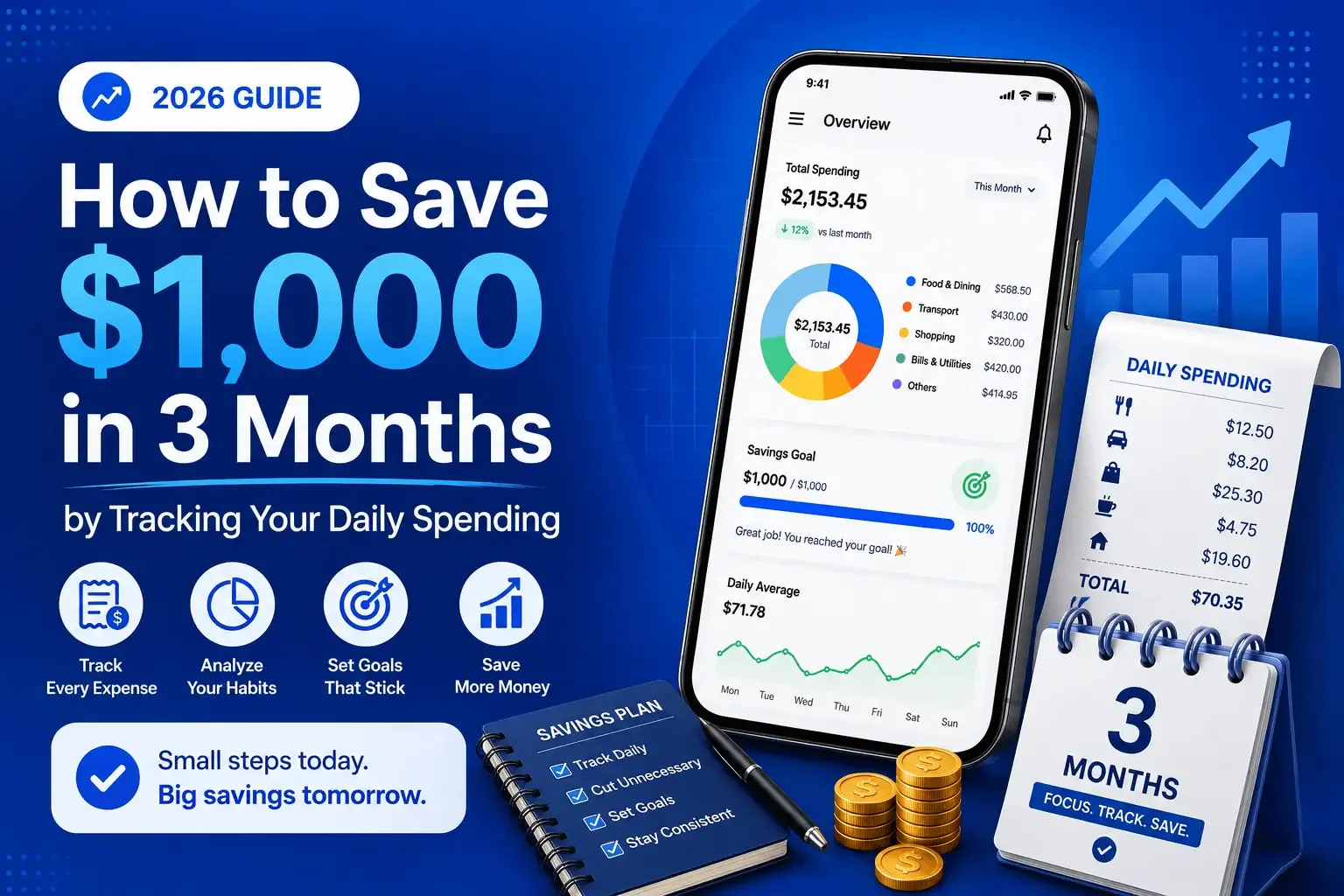
Yes, saving $1,000 in 3 months is achievable for most people — and you don't need to earn more money to do it. The math: $1,000 ÷ 90 days = $11.11 per day. Most people already spend $150–$300/month on purchases they don't remember making — forgotten subscriptions, convenience fees, impulse buys, and food delivery markups. The method: track every single dollar you spend for 90 days using a free app like AI Expense Notebook, identify your spending leaks, cut them deliberately, and redirect that money into savings. No side hustle required.
The Real Reason You Haven't Saved $1,000 Yet
Here is the honest truth about why saving feels hard: it's not your income. It's your visibility. Most people have no idea what they actually spend in a month. Not even close.
56% of people surveyed by The Penny Hoarder said they didn't know how much money they spent last month. The average American spends $219/month on subscriptions alone — but estimates they spend just $86. That's a $133/month blind spot before a single impulse purchase is counted.
When you can't see where your money goes, you can't stop it from leaving. The solution isn't a complicated budgeting system, a second job, or a frugality overhaul. It's much simpler: track every dollar you spend for 90 days. See the leaks. Close them. Watch $1,000 accumulate.
This guide gives you the exact 90-day system — with daily amounts, a week-by-week action plan, a spending leak finder, and a free app that makes tracking take less than 30 seconds a day.
The Math: Breaking $1,000 into Daily Numbers
Before strategy, look at the arithmetic. $1,000 in 3 months (90 days) breaks down into numbers that feel manageable when you see them clearly:
Timeframe | Amount to Save | How It Feels |
Per day | $11.11 | Less than two coffees |
Per week | $77.78 | One skipped dinner out |
Per month | $333.33 | One cable bill + subscriptions you forgot about |
In 90 days | $1,000 | Emergency fund. Vacation. Debt payment. Freedom. |
$11.11 per day. That's all. The challenge isn't the amount — it's finding where $11.11 is currently disappearing without you noticing. That's exactly what daily spending tracking reveals.
Key insight: People who track daily expenses consistently save 15–25% more per month than those who don't — not because tracking is magic, but because seeing real numbers creates real decisions. You can't change what you can't measure.
Where Your $1,000 Is Already Hiding: The 6 Spending Leaks
Before you cut anything deliberately, you need to find your leaks. These are the six categories where most people's $333/month in savings is already sitting — untracked, invisible, and quietly draining:
Leak 1 Forgotten Subscriptions — avg $219/month
The average American pays for 12+ subscriptions but estimates only 4–5. Streaming services you rotate but forgot to cancel, gym memberships used twice, app subscriptions from free trials that quietly converted, cloud storage tiers you upgraded years ago. Each charge feels small. Together they routinely cost $100–$200/month more than people think they're paying.
Leak 2 Food Delivery & Convenience Markups — avg $80–$150/month
Food delivery apps don't just deliver food — they deliver a 30–40% markup on the menu price, plus delivery fee, plus service fee, plus tip. A $14 restaurant meal becomes a $26 delivery. Three deliveries a week costs $78 more per month than the same meals ordered in-person or cooked at home. Most people underestimate their monthly delivery spend by 50% because the fees are buried across multiple apps and feel like separate transactions.
Leak 3 Impulse Purchases Under $20 — avg $60–$120/month
Purchases under $20 feel too small to matter. They are not. A $4 phone game purchase, a $7 online add-on, a $12 item added to a cart to hit the free shipping threshold, a $9 magazine subscription. Individually forgettable. Collectively, sub-$20 impulse purchases account for $60–$120/month for the average person who doesn't track them. They're almost impossible to remember and therefore almost never counted when people estimate their monthly spending.
Leak 4 Convenience Fees & ATM Charges — avg $20–$50/month
Delivery fees, ATM out-of-network charges, rush processing fees, service charges on ticket purchases, foreign transaction fees on cards — these are fees paid on top of the actual purchase price. They feel unavoidable in the moment, but $3 here and $5 there across 30 days routinely adds up to $30–$50 most people never account for.
Leak 5 Eating Out More Than You Think — avg $100–$200/month over estimate
People consistently underestimate how often they eat out. A coffee on the commute, a lunch with a colleague, a quick dinner because cooking felt like too much — each one feels like an exception. Cumulatively, most people eat out 2–3 times more per week than they report when asked. At $12–$18 per meal, that's $96–$216/month of uncounted spending.
Leak 6 Unused Memberships & Annual Fees — avg $30–$80/month amortized
Annual charges — a warehouse club membership, a professional association fee, an annual software subscription, a loyalty card with annual fees — don't appear every month, so they never feel like a monthly cost. Amortized across 12 months, most people carry $400–$960/year in annual fees for services they use infrequently or not at all.
Your Total Potential Monthly Savings From Closing 6 Leaks
Spending Leak | Conservative Save | Aggressive Save |
Forgotten subscriptions | $50 | $130 |
Food delivery markups | $40 | $100 |
Impulse purchases <$20 | $30 | $80 |
Convenience & ATM fees | $20 | $40 |
Eating out (real vs est.) | $50 | $120 |
Unused annual memberships | $20 | $60 |
TOTAL per month | $210 | $530 |
TOTAL in 3 months | $630 | $1,590 |
The conservative column alone gets you past $600 in three months — close the leaks more aggressively and $1,000 in 90 days is well within reach. None of these savings require earning a single extra dollar.
→ See also: Best Alternative to Mint in 2026
How AI Expense Notebook Makes the 90-Day Plan Work
The 90-day tracking plan works on paper. The reason most people don't follow through is friction — logging every expense feels like a chore after the first week. AI Expense Notebook removes that friction.
✦ AI Magic Scan — Receipt Logged in 3 Seconds
Point your camera at any receipt. The AI extracts merchant name, amount, category, tax, and date automatically — no typing, no manual categorisation. For a habit that requires doing it every single day for 90 days, 3 seconds per receipt is the difference between a habit that survives and one that doesn't.
✦ Manual Entry for Cash — 8 Seconds
For cash purchases without receipts — market stalls, tips, cash vending machines — tap 'Add Manually,' enter the amount and category, and save. Eight seconds. This matters because cash purchases are the #1 untracked spending category and a major source of the 'I have no idea where my money went' problem.
✦ Real-Time Budget Bars
Set a monthly budget for each spending category. As you log expenses, the budget bar fills in real time. When Food & Dining hits 80%, you see it immediately — before you've overspent, while you can still decide to cook instead of ordering in. This is the mechanism that turns tracking into behaviour change.
✦ Savings Goal Tracker
Set your $1,000 target and a 90-day deadline. The app calculates exactly how much you need to save per week and shows your progress toward the goal over time. Watching the bar fill over 12 weeks is more motivating than any spreadsheet.
✦ Visual Spending Insights
The Insights tab shows your spending by category for the month, week, or custom range. This is where you find leaks — a category that consistently runs higher than expected is a leak. AI Expense Notebook makes patterns visible that would be invisible in a bank statement full of merchant names and reference numbers.
✦ Monthly Reports — Exportable
At the end of each month, export a full report showing every income and expense, categorised and totalled. Compare month over month to see your progress. By month 3, you have a clear picture of exactly how much you saved — and why, and from which categories.
✦ No Bank Link Required
AI Expense Notebook does not require a bank account connection. All tracking is done through receipt scanning and manual entry. This means no third-party aggregator has access to your credentials, and it works for every payment method — cash, card, mobile payment, foreign currency.
Download AI Expense Notebook free: App Store (iOS) · Google Play (Android)
→ See also: How to stick to a Monthly Budget
The One-Week Spending Audit: Your Starting Point
Before you can save $1,000 in 3 months, you need a baseline. The one-week spending audit gives you real numbers to work from. Here is how to run it:
Day 1: Download AI Expense Notebook and scan your first receipt
The first receipt you scan breaks the inertia. Don't wait for a 'good' day to start. Download the app, open it, and scan the next receipt you receive — whether that's from a coffee shop, a supermarket, or a petrol station.
Days 1–7: Track every single transaction without exception
No purchase is too small to log. A $1.50 vending machine snack. A $0.99 app purchase. A $3 tip. Track all of it. This week is not about judgement — it's about data. The only rule is: if money left your account or wallet, it goes in the app.
Day 7: Open the Insights tab and look at your real numbers
On day 7, open AI Expense Notebook's Insights tab. Look at your total spending for the week. Multiply by 4.3 to estimate monthly spend. Now look at the category breakdown — which category is higher than you expected? That's your first leak.
Day 8: Calculate your monthly savings potential
Take each category that surprised you. Estimate a realistic reduction — not 'spend nothing on food delivery' but 'reduce by $40/month.' Add up your realistic reductions across all surprising categories. If the total is $333 or more per month, $1,000 in 3 months is yours.
What to Do With Your $1,000 Once You've Saved It
Reaching $1,000 in savings is meaningful beyond the number itself. Here is how to deploy it depending on your situation:
→ Build your starter emergency fund
Nearly 40% of Americans couldn't cover a $1,000 emergency expense without going into debt. Your $1,000 is that buffer. Keep it liquid in a high-yield savings account and don't touch it unless a genuine emergency — car repair, medical bill, urgent travel — actually arrives.
→ Pay down high-interest debt
If you're carrying credit card debt at 15–25% APR, paying $1,000 off that balance saves you $150–$250 per year in interest — permanently, without any further effort. High-interest debt is a guaranteed negative return on every dollar you carry.
→ Fund a specific goal
A vacation, a new laptop, a car repair reserve, a course or certification — having $1,000 in savings lets you fund planned expenses without debt. Use AI Expense Notebook's Savings Goal feature to set your next target and keep the momentum going.
→ Start your next 90-day savings cycle
You now have a proven system. You know exactly how you spend. You know where your leaks are. Month 4 is the easiest one — the habits are set, the tracking is automatic, and the savings are already in motion. Set a new $1,000 target and start again.
→ See also: How to set and track savings goals with AI Expense Notebook
Frequently Asked Questions
Q: Is saving $1,000 in 3 months realistic?
A: Yes. Saving $1,000 in 3 months requires setting aside $333 per month or $11.11 per day. For most people, this amount is already being spent on forgotten subscriptions, food delivery markups, impulse purchases, and convenience fees — spending that goes untracked and therefore unchallenged. The method: track every purchase with AI Expense Notebook for 90 days, identify leaks, close them, and redirect the savings. No income increase required.
Q: How can I save $1,000 fast without earning more money?
A: Track every expense for 7 days using AI Expense Notebook to find where money is leaking. The most common sources: forgotten subscriptions ($50–$130/month), food delivery markups ($40–$100/month), impulse purchases under $20 ($30–$80/month), and convenience fees ($20–$40/month). Closing even the conservative estimates across these four categories saves $140–$350/month — enough to hit $1,000 in 3 months without a single extra dollar earned.
Q: What is the best app to save $1,000 in 3 months?
A: The best app to help you save $1,000 in 3 months is AI Expense Notebook, free on iOS and Android. It tracks every purchase through AI receipt scanning (3 seconds per receipt) and manual entry (8 seconds), shows spending by category in real time, alerts you when categories approach their budget limit, and has a Savings Goal feature where you set a $1,000 target with a 90-day deadline. No bank account connection required.
Q: How much do I need to save per day to reach $1,000 in 3 months?
A: To save $1,000 in 3 months (90 days), you need to save $11.11 per day, $77.78 per week, or $333.33 per month. The most practical approach is to identify and eliminate spending leaks totalling $333/month — rather than putting aside $11 cash daily — using an expense tracker like AI Expense Notebook to find where that money is currently going.
Q: What are the biggest spending leaks that prevent saving?
A: The six most common spending leaks are: forgotten subscriptions ($50–$130/month average overspend), food delivery markups and fees ($40–$100/month), impulse purchases under $20 ($30–$80/month), convenience and ATM fees ($20–$50/month), underestimated restaurant spending ($50–$100/month), and unused annual memberships ($20–$60/month amortized). Tracking daily expenses with AI Expense Notebook makes all of these visible within 30 days.
Q: Does tracking expenses actually help you save money?
A: Yes. People who track daily expenses consistently save 15–25% more per month than those who don't. Tracking works because it converts invisible spending into visible data — and visible data creates decisions. You can't change spending you can't see. AI Expense Notebook makes daily tracking take under 30 seconds per expense through AI receipt scanning and quick manual entry, which is why the habit actually survives past week one.
Q: Should I use a separate savings account for my $1,000 goal?
A: Yes. A separate savings account prevents your $1,000 target from mixing with everyday spending. Transfer your weekly or monthly savings amount immediately when you close a spending leak — don't leave it in your main account where it will gradually disappear. Track your savings goal progress in AI Expense Notebook using the built-in Savings Goal feature, which shows how much you've saved and how much remains to hit your target.
Q: Can I save $1,000 in 3 months on a low income?
A: It depends on your fixed costs, but it is often possible even on a modest income. The approach works because it targets discretionary spending leaks — subscriptions, delivery fees, and impulse purchases — which exist at most income levels. On a lower income, the savings may come more slowly ($200–$250/month rather than $333), meaning $1,000 might take 4–5 months rather than 3. Start tracking with AI Expense Notebook to see what your actual leak total is.
Q: How do I track cash expenses when saving $1,000?
A: Use AI Expense Notebook's manual entry feature. Tap 'Add Manually,' select the spending category, enter the cash amount, add an optional note, and save — the process takes 8–10 seconds. Cash tracking is critical because cash purchases are the most commonly untracked expenses and a major source of the gap between what people think they spend and what they actually spend. Track every cash purchase immediately, while the amount is still fresh.
Start Your 90-Day $1,000 Challenge Today
You now have everything you need: the math, the leak finder, the 90-day week-by-week plan, and the tool. The only thing left is starting.
Day 1 has one task: download AI Expense Notebook and scan the next receipt you receive. That's it. Everything else follows from that first log.
- Identify your 6 spending leaks within the first 30 days
- Close $333/month in untracked spending — the $1,000 is already there
- Scan every receipt in 3 seconds with AI Magic Scan
- Log every cash purchase in 8 seconds with manual entry
- Watch your Savings Goal progress bar fill across 90 days
- Export a 3-month report to see exactly where the $1,000 came from
- No bank account connection required — fully private
- Free on iPhone (iOS) and Android
Download AI Expense Notebook Free — Start Your $1,000 Challenge Today