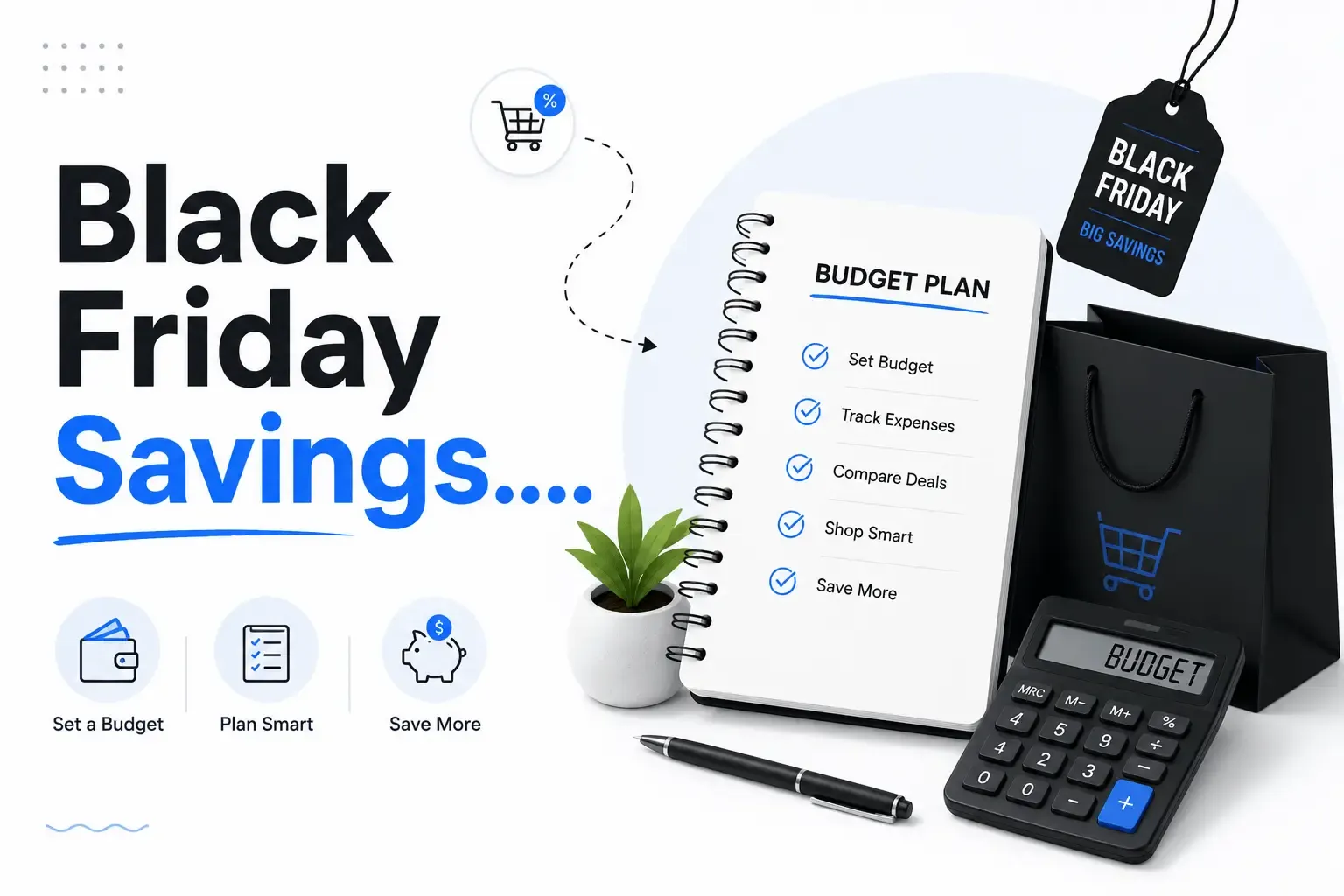
To build a Black Friday budget before you start shopping: (1) Set a firm total spending ceiling before you open a single deal page. (2) Write a specific gift list with a hard price limit per person. (3) Research prices in October so you know a real deal from a fake one. (4) Allocate your total across three categories — gifts, personal purchases, and a buffer. (5) Track every Black Friday purchase in real time with AI Expense Notebook so you see your remaining budget before every transaction, not after.
In 2025, 54% of Black Friday shoppers made at least one impulse buy — and 44% of men and 41% of women regretted their purchases. A budget set before the event is the only thing that stops the psychology of the sale from spending your money for you.
Why Most Black Friday Shoppers Spend More Than They Planned
US shoppers spent a record $11.8 billion online on Black Friday 2025 — up 9.1% year-over-year. Between 10am and 2pm, online carts moved $12.5 million every single minute. 54% of Black Friday shoppers made at least one impulse buy. 33% of all Black Friday transactions in 2025 were impulse purchases. 44% of men and 41% of women reported regretting their Black Friday purchases. Electronics (25%) and clothing (24%) were the most regretted categories. Sources: Adobe Analytics, WiserNotify, GrabOn 2025–2026.
Those numbers tell one story: Black Friday is extraordinarily well-designed to extract money from your wallet before your brain can object. Limited-time countdowns, 'only 3 left' warnings, one-click checkout, and the dopamine hit of seeing a price crossed out — every element of modern Black Friday shopping is engineered to bypass rational decision-making.
The solution is not willpower. Willpower against a billion-dollar retail machine is a losing bet. The solution is a system: a firm budget set before the psychological triggers fire, a specific shopping list written before the deals appear, and a real-time tracker that shows you your remaining budget before every purchase, not in January when the credit card bill arrives.
This guide gives you that system — step by step, with real numbers, and a free app that makes it automatic.
The Real Cost of an Unbudgeted Black Friday
Most people who overspend on Black Friday don't realise it until January. Here is what the math actually looks like when Black Friday has no budget:
Scenario | What Happens | January Reality |
No budget, credit card | Spend $847 across 3 days. Feel great about the 'deals.' | Credit card bill arrives. At 21% APR, carrying $847 for 6 months costs $89 in interest. You paid $936 for $847 worth of stuff. |
Rough mental budget of '$400' | Spend $612 — 53% over the mental limit because nothing tracked it. | The $212 overspend came from 8 purchases under $30 each — none felt significant in the moment. |
Written budget, tracked in real time | Spend $387 of a $400 budget. Skip two items when the tracker shows the limit approaching. | Zero credit card interest. No regret. Two 'skipped' items were forgotten by December. |
Buy Now Pay Later (BNPL) financed $18.2 billion in US holiday purchases in 2024. 42% of BNPL users made at least one late payment in 2025. Carry a $1,500 balance at typical credit card rates and you're still paying for 2025 Black Friday purchases when 2026's Black Friday arrives. Every dollar servicing holiday debt is a dollar not building your emergency fund. Source: Finhabits, Capital One Shopping Research 2025.
→ See also: Best AI Expense Tracker Apps in 2026
The Psychology Behind Black Friday Overspending — And How to Beat It
Understanding why Black Friday spending feels different from regular shopping is the first step to controlling it. Retailers don't just cut prices — they engineer an environment specifically designed to override your financial judgement.
The Dopamine Countdown
When you see a price crossed out and a countdown timer, your brain releases dopamine — the same neurotransmitter triggered by gambling and social media likes. This chemical response creates urgency that feels rational but isn't. The deal feels like it will disappear. Your budget feels less important than acting now.
The fix: Set your budget and list BEFORE you see any countdown timers. Once the dopamine response starts, your budget is already fighting uphill.
The Sunk Cost of 'I'm Already Here'
Once you've driven to a mall or opened a deal website, you feel psychologically invested in buying something. That investment makes off-list purchases feel justified — 'I came all this way, I might as well pick up...' This is how single-item shopping trips become $300 sessions.
The fix: Your list is your permission slip. If it's not on the list, it doesn't exist on Black Friday.
The Relativity Trap
A $50 item marked down from $90 feels like a win — even if you didn't need it and $50 exceeds your remaining budget. The discount becomes the justification for the purchase. 54% of Black Friday shoppers bought items purely because they were on sale, not because they needed or had planned to buy them.
The fix: Ask one question before every purchase: 'Would I buy this at full price?' If no — it's not a deal, it's a trap.
The FOMO Close
'Only 3 left.' 'Sale ends in 4:23.' 'This deal won't come back.' These phrases are designed to prevent comparison shopping and deliberate thought. In 2025, Black Friday 'deals' on many popular items were available at similar prices throughout December — the urgency is manufactured, not real.
The fix: If an item is genuinely on your list and genuinely at the lowest price, buy it. If FOMO is the main reason you're clicking — pause 24 hours.
10 Practical Black Friday Money-Saving Tips for 2026
1. Stack Coupons and Cashback on Top of Sale Prices
Apps like Honey, Rakuten, and Capital One Shopping automatically apply available coupons at checkout and offer cashback on purchases. Install them before Black Friday. A 20% Black Friday discount plus 5% cashback plus a $10 coupon on a $100 item brings your actual cost to $67. Never pay the sale price without checking for additional stacking opportunities.
2. Shop with a Full Stomach and a Full Night's Sleep
This sounds trivial. It isn't. Hunger and fatigue both demonstrably reduce impulse control — and Black Friday in-store shopping is specifically timed to catch people in a depleted state. The morning crowd at a 5am opening is operating on 4 hours of sleep. Shop online from home after breakfast if possible — your budget will thank you.
3. Use a Dedicated Shopping Card with a Pre-Loaded Limit
If you use a credit card, load a prepaid debit card with exactly your Black Friday budget. When the card hits zero, shopping stops — no exceptions, no 'I'll pay it back next month.' This is the single most effective mechanical enforcement of a Black Friday budget. Pair it with AI Expense Notebook tracking for double protection.
4. Check Return Policies Before You Buy
Many Black Friday items — particularly electronics — come with shortened return windows, final-sale conditions, or restocking fees. Before purchasing any item over $50, check: how many days for return, is the return free, and are there restocking fees. A non-returnable impulse purchase that doesn't work as expected is a permanent loss.
5. Compare In-Store vs. Online Prices in Real Time
In-store Black Friday prices are not always the lowest. Before buying anything in-store, check the same item's price online on your phone. Many retailers price-match their own online store. Target, Best Buy, and Walmart all offer price-matching during Cyber Week — just ask at the register.
6. Avoid BNPL for Items Not Already in Your Budget
Buy Now Pay Later services make expensive items feel affordable by splitting the pain across 4 or 6 payments. They also make it easy to commit to purchases that exceed your budget because the full cost isn't visible at checkout. 42% of BNPL users made a late payment in 2025. Only use BNPL for items already in your budget — never as a way to spend beyond it.
7. Track Every Purchase as You Make It — Not at End of Day
End-of-day budget reviews miss the problem. By the time you add up your Black Friday purchases at 9pm, the purchases are made and the budget is already breached. Log every purchase in AI Expense Notebook the moment you make it — in-store with a 3-second scan, online with an 8-second manual entry. Real-time tracking is the difference between a guardrail and a report.
8. Give Every 'Off-List' Item the 24-Hour Test
Any item not on your pre-written list gets the 24-hour rule: screenshot, wait, decide tomorrow. 72% of impulse purchases feel unnecessary within 24 hours. If the deal has genuinely expired by then, it was FOMO, not a real need. If the deal is still live and you still want it — and you have budget — then it's a considered purchase, not an impulse.
9. Set a Cut-Off Time on Black Friday and Stick to It
Decide in advance when Black Friday shopping ends for you — say, 8pm on Friday and 10pm on Cyber Monday. Late-night shopping sessions are when the most regretted purchases happen: fatigue is high, restraint is low, and 'just one more' becomes five more. When your cut-off arrives, close the tabs.
10. Review Your Spending Before Cyber Monday Opens
On Saturday after Black Friday, open AI Expense Notebook and review what you spent against your budget. See what's left. Adjust your Cyber Monday plan based on real data — not on how you feel about what you spent. If you came in under budget, you have room. If you hit the ceiling, Cyber Monday is a browsing day only.
How AI Expense Notebook Keeps Your Black Friday Budget on Track
Setting a budget before Black Friday is step one. The budget only works if something enforces it in real time — at the moment of purchase, not days later when the damage is done.
✦ Real-Time Budget Bars — Know Your Remaining Budget Before Every Click
When you set your Black Friday budget in AI Expense Notebook and log each purchase, the budget bar for each category updates instantly. Before you add a $79 item to your cart, open the app. If your Gifts bar shows $45 remaining from a $300 budget, you know the decision before you make it — not after checkout. That 10-second check is what separates people who stay on budget from people who don't.
✦ AI Magic Scan — Log In-Store Receipts in 3 Seconds
For every Black Friday in-store purchase, scan the receipt immediately with AI Expense Notebook's AI Magic Scan. Point camera at the receipt — AI extracts merchant, amount, and category automatically in under 3 seconds. Confirm and it's logged. Your remaining budget updates before you've left the shop. Works on any printed receipt, including gift receipts.
✦ Manual Entry — Log Online Orders in 8 Seconds
For Amazon, ASOS, Apple, or any other online Black Friday purchase, tap Add Manually the moment you place the order. Enter the amount, select category (Gifts or Personal), tap save. Eight seconds. Your budget reflects money committed, not just money delivered — which is the number that matters on Black Friday weekend.
✦ Savings Goal — Track What You Actually Saved
After Black Friday, open AI Expense Notebook's Savings Goal feature. Set a target called 'Christmas Fund' and log the difference between what you would have spent without a budget and what you actually spent. Seeing the saving as a positive number — $143 saved vs. last year — is more motivating than just seeing spending numbers.
Download AI Expense Notebook free: App Store (iOS) · Google Play (Android)
Black Friday vs. Cyber Monday 2026: When to Buy What
Not every category has its best deals on Black Friday. Knowing which day wins for which product type helps you plan purchases across the full Cyber Week and resist impulse buys on the wrong day.
Category | Best Day | Typical Discount | Notes |
TVs & large electronics | Black Friday | 20–40% | Retailers push biggest TV deals on BF specifically |
Laptops & computers | Cyber Monday | 15–35% | Tech retailers save best laptop deals for CM |
Clothing & fashion | Black Friday | 30–60% | Fashion brands go deepest on BF — CM is leftover stock |
Toys & games | Black Friday | 20–40% | Most popular toys sell out BF — don't wait for CM |
Software & subscriptions | Cyber Monday | 40–70% | SaaS and app deals peak on CM, often extend to Dec |
Home appliances | Black Friday | 15–30% | White goods move on BF — kitchen, laundry, cleaning |
Shoes & sportswear | Both days | 20–50% | Nike, Adidas often run identical discounts across BF+CM |
Jewellery & accessories | Cyber Monday | 20–40% | Fine jewellery deals skew CM and the week after |
Books & courses | Cyber Monday | 40–80% | Education deals peak CM — Udemy, Coursera, Kindle |
Travel & experiences | Cyber Monday | 20–40% | Flight and hotel deals traditionally stronger on CM |
Key insight from 2025 data: Black Friday captured 31% of total Cyber Week revenue in a single day — with transaction volumes exceeding Cyber Monday by 12%. Black Friday is now definitively the bigger shopping day. Plan your most important purchases for Black Friday and use Cyber Monday for technology and software where CM genuinely wins.
Frequently Asked Questions
Q: How do I set a budget for Black Friday?
A: Set a firm total spending ceiling before you research any deals — not after you've seen what's on sale. Split it across three categories: gifts (70–80%), personal purchases (10–15%), and a buffer for surprises (10–15%). Write a specific gift list with a hard price limit per person before the event. Track every purchase in real time with AI Expense Notebook so you see your remaining budget before every transaction, not after.
Q: How much do people overspend on Black Friday?
A: In 2025, 54% of Black Friday shoppers made at least one impulse buy, and 33% of all Black Friday transactions were impulse purchases. 44% of men and 41% of women reported regretting their Black Friday purchases. Electronics (25%) and clothing (24%) were the most regretted categories. The average consumer spent $254 per month on impulse buys in 2025 — Black Friday is the single highest-risk day for impulse spending in the year.
Q: What is the best app to track Black Friday spending?
A: The best app to track Black Friday spending in 2026 is AI Expense Notebook, free on iOS and Android. Set your Black Friday budget by category before the event. Scan in-store receipts in 3 seconds with AI Magic Scan. Log online orders manually in 8 seconds. Real-time budget bars show your remaining allowance before every purchase decision. No bank account connection required.
Q: Is Black Friday or Cyber Monday better for deals?
A: It depends on the category. Black Friday is better for TVs, large appliances, clothing, fashion, and toys — these categories see the deepest discounts on Friday. Cyber Monday is better for laptops, software, subscriptions, books, courses, and travel deals. In 2025, Black Friday captured 31% of total Cyber Week revenue in a single day — with transaction volumes exceeding Cyber Monday by 12%.
Q: How do I avoid impulse buying on Black Friday?
A: Five practical steps: (1) Write your gift list with per-person price limits before Black Friday. (2) Research actual prices in October so you recognise real discounts. (3) Apply the 24-hour rule to every off-list item — wait a day before buying. (4) Set a budget in AI Expense Notebook and check your remaining balance before every purchase. (5) Set a shopping cut-off time and close all tabs when it arrives.
Q: Should I use Buy Now Pay Later on Black Friday?
A: Only for items already in your budget — never as a way to spend beyond it. 42% of BNPL users made at least one late payment in 2025, up from 34% in 2023. BNPL makes expensive items feel affordable by hiding the full cost at checkout, which is exactly why Black Friday impulse purchases via BNPL are so risky. Log every BNPL order immediately in AI Expense Notebook — you've committed the money even if payment is deferred.
Q: How do I know if a Black Friday deal is real?
A: Check the item's price history before Black Friday using CamelCamelCamel.com for Amazon products or Google Shopping for broad comparisons. If the 'original price' was only set 2–3 weeks before Black Friday, it's a manufactured reference. A genuine deal is below the item's price for the preceding 90 days. Research your specific items in October — you'll know a real deal instantly when you see one.
Set Your Budget Now — Before the Deals Start
Black Friday 2026 is November 27th. The deals start the first week of November and the psychological pressure starts the moment you see the first countdown timer. Your budget needs to exist before any of that.
Set your ceiling today. Write your list this week. Download AI Expense Notebook, set your three category budgets, and walk into Black Friday with a system — not a rough intention. The shoppers who come out ahead every year aren't the ones with the most willpower. They're the ones with the plan already in place before the dopamine starts firing.
- Set your total Black Friday ceiling before researching any deals
- Write your gift list with a hard price limit per person
- Research real prices in October — know a genuine deal when you see one
- Log every in-store purchase in 3 seconds with AI Magic Scan
- Log every online order in 8 seconds the moment you place it
- Check your real-time budget bar before every purchase decision
- Apply the 24-hour rule to every off-list item
- Free on iPhone and Android — no bank connection required
Download AI Expense Notebook Free — Set Your Black Friday Budget Today